

The industrial client successfully localized the production of critical valve components using reverse engineering and quality assurance. Facing a lack of original design specifications, the client employed 3D scanning to create accurate CAD models. Subsequent quality inspection ensured the manufactured parts met required standards. This approach enabled the client to establish local production, secure reliable component quality, and mitigate production risks associated with missing specifications. The study demonstrates the effectiveness of combining reverse engineering with quality control to overcome manufacturing challenges.

An industrial client sought to bring the production of critical valve components – specifically the valve body, valve ball, and bonnet – to a local manufacturing facility. This move aimed to enhance supply chain resilience and potentially reduce lead times. However, the client lacked the precise engineering drawings or CAD models required to manufacture these components accurately.
Reproducing these parts without exact specifications risked creating components that wouldn't fit, function correctly, or meet required performance standards, leading to wasted resources and production setbacks. Accurate reverse engineering was paramount for successful localized production.
We delivered a comprehensive, two-stage solution combining reverse engineering and quality verification:
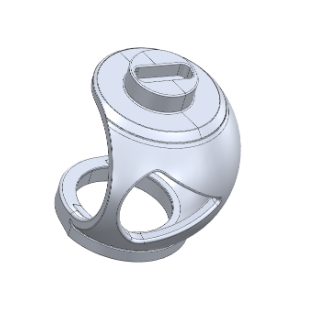
3D Scanning & Reverse Engineering: Our team utilized metrology-grade 3D scanners to capture the intricate geometries of the existing valve body, valve ball, and bonnet with high precision. This detailed scan data was then expertly converted into highly accurate, manufacturing-ready CAD models.
Manufacturing Quality Assurance: After the client used our CAD models to manufacture the components locally, we performed a rigorous CAD-to-part inspection. This involved scanning the newly produced parts and comparing them directly against the original CAD models to verify dimensional accuracy.
-min.jpg)
.svg)
